Bus Ramp Fallout
What started as a normal day unraveled at the bus ramp. The energy shifted before anyone even understood the full story. There were whispers about how intense it got, how it almost turned into something worse. No one was clear on whether punches were thrown, but everyone agreed it escalated quickly. The kind of moment that makes the school say, “We’ll be calling home.”
The tension wasn’t just about the fight. It was about communication. Why didn’t Destiny say anything? Why did someone else have to deliver the news? That question carried more weight than the incident itself. When people choose not to tell you something, it says more than the event ever could. It suggests they’re worried about your reaction. It hints at fear, or at least caution.
And that realization stung.
The Fear of Reaction
When Bethany asked why Destiny hadn’t come to her directly, the answer was careful but honest: “We already know how you can react.” That sentence landed hard. It wasn’t an accusation, but it was a reflection. Sometimes the way people respond in past situations shapes how much information they receive in the future.
No one likes to feel managed or filtered. It can feel like disrespect. But from another angle, it can also be protection—an attempt to prevent escalation. In families, especially blended ones, emotions travel fast. A small spark can become a house fire if the wrong person feels cornered.
The issue wasn’t just the bus ramp. It was the anticipation of someone’s temper, someone’s pride, someone’s instinct to defend.
A Father’s Visit
Then came the bigger wave: Bethany’s father had already stopped by.
He wasn’t calm. He wasn’t subtle. He was a father who had seen his daughter’s face after a fight. That alone was enough to ignite him. To him, this wasn’t about technicalities or timing. It was about protection. His baby girl had been hurt.
Larry understood that part. He said he respected her father. He respected his elders. But respect becomes complicated when it feels one-sided.
Bethany’s father didn’t come in asking questions. He came in with conclusions.
The Line Between Respect and Pride
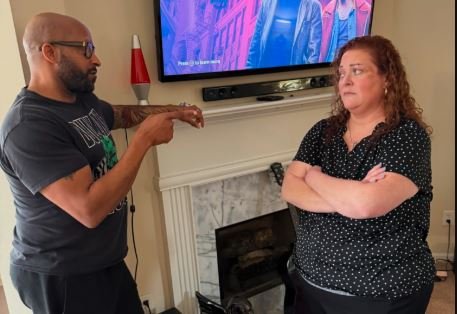
Larry described the conversation as walking a thin line. He said it took everything in him not to cross it. That says a lot. When a man feels challenged in his own home, it hits differently. When another man questions his ability to protect his wife, it hits even deeper.
Larry felt accused—not just of being slow, but of failing. Worse, he felt his military service was being dragged into it. For him, that wasn’t just a job. It was identity. It was discipline, training, and sacrifice.
So when Bethany’s father implied he should have moved faster, should have done more, it felt like a direct strike to his competence.
And yet, Larry stayed calm.
That restraint mattered.
The Superhero Expectation
“Why does everybody think I’m this superhero guy?”
That line revealed something beneath the anger. Larry wasn’t just defensive. He was overwhelmed. There’s a pressure that comes with being seen as the protector. The strong one. The man who always knows what to do.
But real life isn’t a movie. In chaos, decisions happen in seconds. Larry said he grabbed the aggressor first. As a former military cop, that’s what he was trained to do—neutralize the threat. From his perspective, he did exactly what he was supposed to.
From Bethany’s father’s perspective, it wasn’t fast enough.
From Bethany’s perspective, it felt like he went to the other girl before her.
Same moment. Three different interpretations.
This Is My House
The tension peaked when Larry made one thing clear: this is his home.
That statement wasn’t about ownership alone. It was about authority. He felt another man entered his space and spoke to him in a way that crossed boundaries. He tolerated it out of respect—for Bethany and for her father’s age—but he made it clear it wouldn’t happen again.
There’s something fragile about pride when it’s challenged publicly or within your own walls. Larry didn’t yell. He didn’t escalate. But he drew a line.
He said next time, it would go differently.
That wasn’t a threat. It was a warning born from wounded pride.
Bethany’s Perspective
Bethany wasn’t dismissing her father. She understood his reaction. She had been upset too. In her mind, her father’s anger wasn’t disrespect—it was protection.
She even admitted she told her father it felt like Larry took a long time to reach her. That honesty complicated everything. Larry wasn’t just reacting to a father’s accusation. He was reacting to his wife’s agreement with it.
That’s what hurt most.
It’s one thing to feel attacked by an in-law. It’s another to feel unsupported by your partner.
Two Kinds of Protection
At the heart of the conflict were two men trying to protect the same woman.
Bethany’s father protects with emotion. His instinct is immediate defense, no matter who stands in front of him.
Larry protects with training. His instinct is to assess, neutralize, and control the threat.
Both approaches come from care. But they clash because they’re rooted in different identities.
One says, “You should have moved faster.”
The other says, “I followed protocol.”
And in the middle stands Bethany, wanting to feel safe without choosing sides.
The Real Issue
This wasn’t really about Montana. Or the bus ramp. Or even the fight itself.
It was about communication, ego, and expectation.
Larry felt disrespected.
Bethany felt vulnerable.
Her father felt furious.
And none of them felt fully understood.
Moving Forward
The final exchange softened slightly. Bethany acknowledged why her father spoke the way he did. Larry asked that she understand his perspective next time.
That’s the turning point.
Not the warning.
Not the pride.
But the request for mutual understanding.
In blended families, boundaries are delicate. Respect has to flow in all directions—between spouses, between parents, and between generations. When one link weakens, the whole structure shakes.
The fight at the bus ramp will fade.
The conversation in the living room is what will linger.
Because at the end of the day, protection without communication feels like control. And respect without empathy feels like dominance.
What this family needs isn’t a superhero.
It needs alignment.